Designing with Loon Seamless Pattern Background Repeats for Cottage Aesthetic Projects
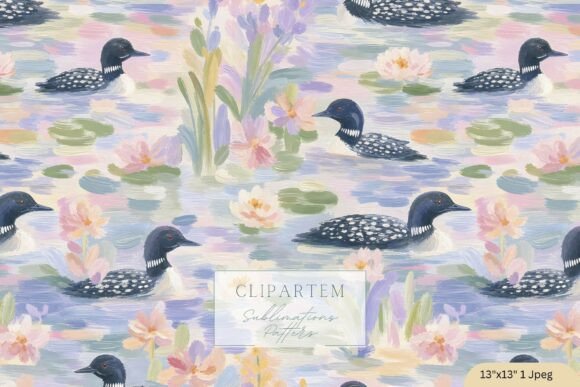
The intersection of digital art and traditional craftsmanship has opened new avenues for creators seeking to infuse their projects with a sense of calm and natural beauty. Among the most sought-after visual elements in contemporary design are patterns that evoke specific moods, particularly those rooted in nature. The Loon Seamless Pattern Background Repeats represent a prime example of how digital assets can bridge the gap between impressionistic painting and functional surface design. By utilizing soft brushstrokes in blush pink, lavender, sage green, and dusty blue, these patterns capture the ethereal quality of a misty lake morning, offering a versatile foundation for a wide array of creative endeavors.
The Artistic Composition of Misty Lake Motifs
Understanding the visual language of a seamless pattern is crucial for designers who wish to integrate it effectively into their work. The specific aesthetic of the loon and water lily motif relies heavily on an impressionistic approach. Unlike sharp, vector-based graphics that define modern minimalism, this style embraces the softness of hand-painted textures. The use of blush pink and lavender suggests the early light of dawn breaking over water, while sage green and dusty blue ground the composition in the organic reality of foliage and deep water.
This color palette is not merely decorative; it serves a psychological function. In color theory, cool tones mixed with muted pastels are known to induce relaxation and focus. For professionals creating branding materials for wellness centers, yoga studios, or boutique hospitality services, the Loon Seamless Pattern Background Repeats offer an immediate atmospheric shift. The "dreamy" quality mentioned in product descriptions is achieved through the lack of hard edges, allowing the eye to wander across the surface without encountering visual friction. This makes the pattern particularly effective for large-scale applications where a busy or high-contrast design might become overwhelming.
Technical Specifications and File Integrity
For any digital asset to be truly useful in a professional workflow, its technical specifications must align with industry standards. The utility of these patterns hinges on their resolution and format. A standard requirement for high-quality printing is a resolution of 300 DPI (dots per inch). This ensures that whether the pattern is printed on a small greeting card or a large roll of wallpaper, the image remains crisp and free from pixelation. The delivery of such assets typically comes in the JPEG format, which provides a balance between file size and image quality, though it is essential to note that JPEGs utilize RGB color mode.
While RGB is ideal for digital displays and many modern home printers, professionals working in commercial offset printing should be aware of the potential need for color conversion to CMYK. However, the richness of the lavender and sage hues in these specific designs usually translates well, maintaining their integrity even after conversion. The defining feature of this asset is its status as a true seamless tile. This means the image is engineered so that when placed side-by-side horizontally and vertically, the edges match perfectly without visible seams. This mathematical precision in the artwork allows for infinite repetition, a critical factor for surface pattern design mockups and fabric printing.
Diverse Applications in Surface Design and Manufacturing
The versatility of the Loon Seamless Pattern Background Repeats extends far beyond simple digital backgrounds. One of the primary use cases lies in the realm of textile design. The cottage-core aesthetic, which celebrates rural simplicity and nostalgia, has seen a surge in popularity within the fashion and home decor industries. Designers can apply this pattern to various fabrics using print-on-demand services or local textile printers. The soft, painterly nature of the loons and lilies works exceptionally well on natural fibers like linen, cotton, and canvas, enhancing the organic feel of the final product.
Consider the application in gift wrap and tissue paper. Standard commercial wrapping papers often feature repetitive, mechanical-looking graphics. By utilizing a high-resolution seamless pattern with an artistic flair, small business owners can elevate their packaging game. A boutique selling handmade soaps or artisanal candles could use this pattern to line their boxes or wrap their products, instantly communicating a brand identity centered on nature, tranquility, and handcrafted quality. Similarly, in the stationery industry, this pattern serves as an excellent base for cards and paper goods. The negative space created by the water and sky elements in the design provides ample room for typography, making it suitable for wedding invitations, journal covers, or thank-you notes.
Implementing Patterns in Home Décor and Branding
Beyond physical goods, the integration of these patterns into interior design projects offers a unique opportunity to transform spaces. Wallpaper projects, whether using traditional paste or modern peel-and-stick vinyl, benefit immensely from seamless tiles. A feature wall adorned with the misty lake motif can turn a bedroom or reading nook into a serene retreat. The scale of the repeat is important here; designers must calculate the repeat size relative to the wall dimensions to ensure the pattern flows naturally without awkward cuts at corners or ceilings.
In the digital sphere, the Loon Seamless Pattern Background Repeats are invaluable for branding and web design. A "lakehouse aesthetic" is a growing trend in lifestyle blogging and real estate marketing. Websites and social media graphics utilizing this background can create a cohesive visual narrative. For educators and researchers creating presentations on environmental topics or literature involving nature, such a background adds thematic depth without distracting from the foreground content. The low-contrast nature of the dusty blues and greens ensures that text overlaid on the pattern remains legible, provided appropriate font weights and colors are chosen.
Workflow Considerations for Creators and Hobbyists
Integrating a seamless pattern into a project requires a understanding of how tiling works in various software environments. For users of Adobe Photoshop, Illustrator, or Affinity Designer, the process typically involves defining the downloaded JPEG as a pattern swatch. Once defined, the pattern can be applied to any shape or layer, allowing for non-destructive editing. This flexibility is crucial for hobbyists experimenting with digital scrapbooking or nature journaling. The ability to scale the pattern up or down without losing the seamless property allows for creative layering, where the loon motif might serve as a subtle texture behind more prominent illustrative elements.
It is also worth noting the distinction between personal and commercial use licenses often associated with digital downloads. While the file itself is ready for immediate use, creators intending to sell products featuring the Loon Seamless Pattern Background Repeats must verify the licensing terms provided by the artist. Many independent artists allow for small-batch commercial use, which empowers hobbyists to turn their crafting passion into a small business. This democratization of design resources allows individuals to produce professional-grade goods like tote bags, pouches, and accessories without needing to commission original artwork from scratch.
The Role of Digital Downloads in Modern Creativity
The shift towards digital downloads has revolutionized how creative assets are distributed and utilized. The immediacy of receiving a high-resolution file allows for rapid prototyping. A designer can download the asset, apply it to a mockup of a fabric bolt or a wallpaper roll, and present a concept to a client within minutes. This speed facilitates a more iterative design process, where variations in color saturation or scale can be tested quickly. Furthermore, the lack of physical shipping reduces the carbon footprint associated with acquiring design materials, aligning with the eco-conscious values often held by the target audience of nature-inspired art.
However, users must remain mindful of the limitations of raster images (JPEGs). While 300 DPI is sufficient for most print applications, enlarging the pattern significantly beyond its original dimensions can eventually lead to a loss of clarity. For massive installations, such as full-room murals, it may be necessary to work with the artist to obtain a vector version or a higher-resolution source file if available. Despite this, for the vast majority of applications listed—from stationery to apparel—the provided resolution strikes an optimal balance between usability and file manageability.
Cultivating a Cohesive Aesthetic Identity
Ultimately, the value of the Loon Seamless Pattern Background Repeats lies in its ability to convey a specific emotional resonance. In a world saturated with loud, aggressive marketing visuals, the subtlety of a misty lake morning offers a refreshing alternative. It invites the viewer to pause and reflect. For business owners, adopting this aesthetic can differentiate their brand as one that values mindfulness and natural beauty. For educators, it provides a calming backdrop that can enhance the learning environment. For the individual hobbyist, it offers a tool to bring a touch of the outdoors into their daily creative practice.
The successful deployment of such a pattern requires a thoughtful approach to composition. Whether used as a dominant feature or a supporting texture, the interplay of the blush, lavender, sage, and blue tones must be harmonized with other design elements. When executed with care, these seamless repeats do more than fill space; they tell a story of quiet mornings, still waters, and the gentle presence of wildlife, enriching the tangible and digital objects we interact with every day. As the demand for authentic, nature-connected design continues to grow, assets like these will remain indispensable tools for creators across all disciplines.